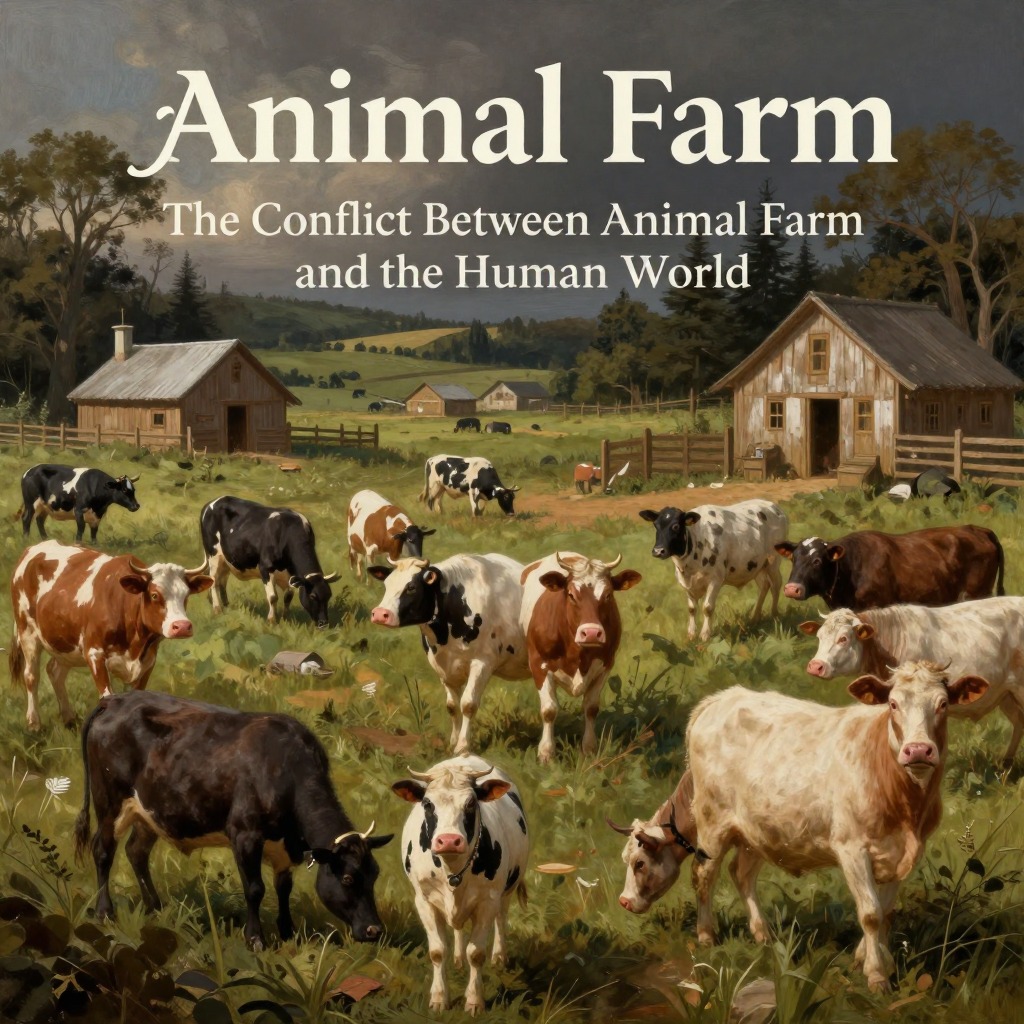
Animal Farm Begins Trade with Humans
Animal Farm Begins Trade with Humans represents the first systematic breach of the Rebellion's core prohibitions, transforming the farm from a self-sufficient revolutionary commune into a participant in the very human economic system it had been founded to reject. The decision, announced by Napoleon on a Sunday morning, was framed as a practical necessity: the windmill project required paraffin oil, nails, string, dog biscuits, and iron for horses' shoes—none of which could be produced on the farm. Later needs would include seeds, artificial manures, tools, and ultimately the windmill's machinery itself. Napoleon declared that the windmill's needs must override everything else, and he had already made arrangements to sell a stack of hay and part of the current year's wheat crop, with the possibility of selling eggs—for which there was always a market in Willingdon—if more money were needed. The hens, he said, should welcome this sacrifice as their own special contribution toward the building of the windmill.
The Intermediary and the New Arrangement
To avoid direct contact between animals and humans—which Napoleon acknowledged would be "most undesirable"—he appointed a human intermediary. Mr. Whymper, a sly-looking solicitor with side whiskers who lived in Willingdon, had realized earlier than anyone else that Animal Farm would need a broker and that the commissions would be worth having. He agreed to visit the farm every Monday morning to receive his instructions. The animals watched his coming and going with a kind of dread and avoided him as much as possible. Nevertheless, the sight of Napoleon, on all fours, delivering orders to Whymper, who stood on two legs, roused their pride and partly reconciled them to the new arrangement. Their relations with the human race were now not quite the same as they had been before.
The Erasure of Memory and the Role of Squealer
The animals were conscious of a vague uneasiness. They remembered—or thought they remembered—that among the earliest resolutions passed at that first triumphant Meeting after Jones was expelled had been the prohibitions against any dealings with human beings, engaging in trade, and making use of money. The four young pigs who had protested when Napoleon abolished the Sunday Meetings raised their voices timidly, but they were promptly silenced by a tremendous growling from the dogs. Then, as usual, the sheep broke into "Four legs good, two legs bad!" and the momentary awkwardness was smoothed over. Afterwards, Squealer made a round of the farm and set the animals' minds at rest. He assured them that the resolution against engaging in trade and using money had never been passed, or even suggested—it was pure imagination, probably traceable in the beginning to lies circulated by Snowball. When a few animals still felt faintly doubtful, Squealer asked them shrewdly, "Are you certain that this is not something that you have dreamed, comrades? Have you any record of such a resolution? Is it written down anywhere?" Since nothing of the kind existed in writing, the animals were satisfied that they had been mistaken. This technique of denying the past by demanding written proof—which the pigs themselves controlled—became a recurring pattern. The same logic was later used to justify the pigs moving into the farmhouse and sleeping in the beds, with Squealer arguing that the Fourth Commandment only forbade sleeping in a bed "with sheets," which the pigs had removed.
The Broader Context of the Decision
The decision to trade was not an isolated event but part of a larger pattern of the pigs' increasing privilege and the erosion of revolutionary ideals. Earlier, the pigs had already reserved the milk and windfall apples for themselves, arguing through Squealer that these were necessary for their health as brainworkers and that if they failed in their duty, Jones would come back. The animals, certain that they did not want Jones back, had no more to say. The same argument—"Surely, comrades, you do not want Jones back?"—was used to justify the abolition of Sunday Meetings after Snowball's expulsion, and Boxer had adopted the maxim "If Comrade Napoleon says it, it must be right." The trade with humans thus stood as the latest in a series of steps by which the pigs consolidated power and abandoned the original principles of Animalism, all while maintaining the fiction that nothing had changed.
Consequences and Significance
The initiation of trade had far-reaching consequences. It opened the door to a series of further compromises: the pigs moved into the farmhouse, the Seven Commandments were quietly amended, and eventually the farm entered into a complex and treacherous business relationship with both Mr. Pilkington of Foxwood and Mr. Frederick of Pinchfield, culminating in the forged banknote scandal and the Battle of the Windmill. The trade also introduced a permanent human presence into the farm's affairs through Whymper, who became a regular visitor. The animals' pride at seeing Napoleon give orders to a human being on two legs partly reconciled them to the arrangement, but it also marked the beginning of the normalization of human-animal contact that would eventually lead to the pigs walking on their hind legs, wearing clothes, and entertaining human farmers at the farmhouse table. The decision to trade was thus not merely a practical measure but a fundamental betrayal of the Rebellion's promise of animal self-sufficiency and separation from human tyranny.